
Reports

2025/06/06
The design duo Kateřina Goryczka and Oto Melter are celebrating international success - their project Bench X, created at the Laboratory of Innovation at the Klokner Institute of CTU, has won a prestigious award in the SIT Furniture Design Award 2025. It was awarded in the Public Park & Public Area Furniture category for its innovative combination of technology, aesthetics and social impact.
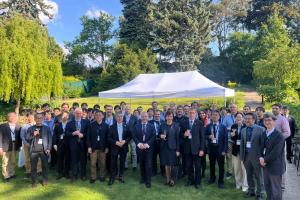
Faculty of Nuclear Sciences and Physical Engineering CTU in Prague hosted a number of leading Japanese and Czech experts in the field of quantum technologies on 27-29 May 2025. This was the second meeting, which follows the first workshop held in Tokyo in May 2024. The idea to organize joint meetings in the dynamically developing field of quantum technologies was born in 2023 during bilateral consultations between the Government of the Empire of Japan and the Czech Republic and on the initiative of the Ambassador of the Empire of Japan, His Excellency Hideo Suzuki, prof. Akira Furusawi (University of Tokyo), Prof. Radim Filip (Palacký University) and Prof. Igor Jex (Czech Technical University in Prague).
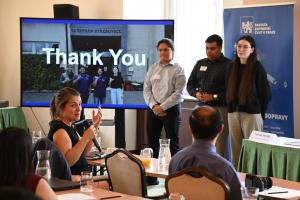
When in May 2015, the then Dean of the Faculty, Prof. Miroslav Svítek, invited several of his colleagues from all over the world to a small meeting whose main topic was the newly emerging field of Smart Cities, few had any idea to how an important international event this symposium would grow into.
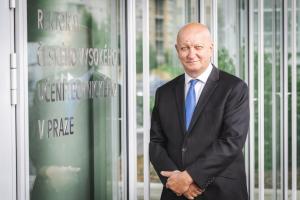
On 21 May, the Academic Senate of the CTU approved the proposal to dismiss Vojtěch Petráček from the post of Rector of the university. At the proposal of the Senate, President Petr Pavel decided to dismiss Petráček on 30 May. The dismissal must still be signed by Prime Minister Petr Fiala.
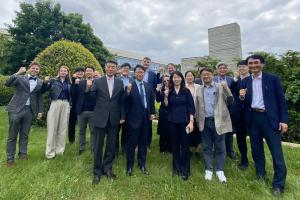
In May, the Czech Technical University in Prague (CTU) hosted a meeting related to the ongoing project “Joint Cooperative Research Focused on the Transfer of Technological Knowledge and Qualification of Accident-Tolerant Fuel for New Nuclear Power Plants,” which aims to enhance the readiness of the Czech nuclear sector for the Korean APR reactor technology.
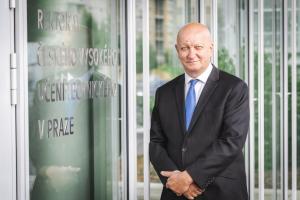
An extraordinary session of the Academic Senate of CTU was held on Wednesday afternoon, 21 May, with a single item on the agenda: a motion to dismiss Rector Vojtěch Petráček from his position, submitted on Tuesday 13 May by Senator Jiří Vokřínek. Rector Vojtěch Petráček is leading the CTU in his second term of office, which was due to end in January 2026, eight months from now.
2025/05/15
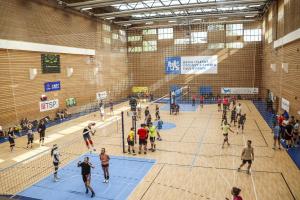
Traditionally, the Rector's Sports Day is held in mid-May. This year the weather was really favourable to the last bit, it did not rain, nor was it unbearably hot. Thus, nothing prevented sports outdoors or indoors and the participation of students and staff in the Institute of Physical Education and Sport exceeded 1000 athletes in various sports disciplines.
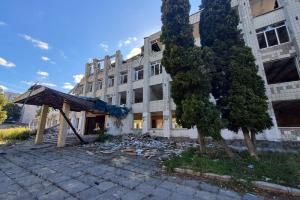
At the Masaryk Institute of Advanced Studies of CTU, a creative team of educators is starting the initial phase of work on the continuation of last year's grant Strengthening Capacity and Knowledge Transfer at Higher Education Institutions for the Development of Affected Areas of Ukraine. The project is implemented with financial support from the Ministry of Foreign Affairs of the Czech Republic under the CzechAid foreign development cooperation programme.

2025/05/12
Ensuring crew self-sufficiency in space is one of the current challenges. Scientists from the Institute of Chemical Processes of the Czech Academy of Sciences (CAS) and other partners will contribute to solving it with the METRO experiment, which will investigate the control of gas transfer in microgravity for efficient long-term operation of space photobioreactors. Once tested, these could in the future provide astronauts with continuous production of oxygen and food from carbon dioxide and water. The experiment was selected by the Department of Transportation for implementation during the flight of Czech astronaut Aleš Svoboda to the International Space Station (ISS).
2025/05/07
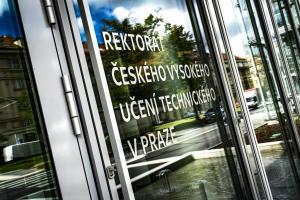
The document "Security Policy of CTU" came into force on 1 May 2025 as an order of the Rector. This is another crucial step by which the technical university protects its students, staff and academics as well as the general public.