
Reports

A total of 327.5 billion crowns will come from investments to achieve the goal of developing renewable resources, which was set by the Ministry of Industry and Trade of the Czech Republic. The amount was calculated by experts from the Faculty of Electrical Engineering of the Czech Technical University and the Chamber of Renewable Energy Sources. According to a study by the Chamber, approximately 70 billion crowns of public support will be needed to trigger these investments. The Modernization Fund will be key, the conditions of which are currently being finalized by the Ministry of the Environment of the Czech Republic.
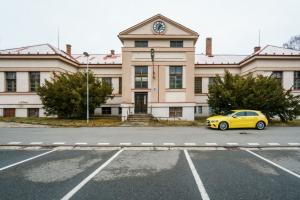
In the area of the former barracks in Kladno, one of the buildings should be newly used as a teaching base for the study program Laboratory Diagnostics in Healthcare with first-class laboratories of microbiology, immunology, biochemistry and others and with classrooms or lecture rooms.
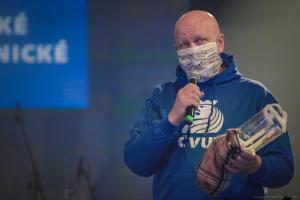
A virtual music festival of 9 bands and musicians took place in the Lucerna Music Bar from 4.30 pm to 11 pm on Wednesday, 13 May, 2020. The event with the motto "Musicians to Scientists: Man Science of Art Tolerance" was accompanied by the Rector of CTU doc. Vojtěch Petráček.

The Faculty of Information Technology of the Czech Technical University in Prague (FIT CTU) ranks first in the ranking of teams of Czech academic institutions that provided their computing power to the Folding @ home project, and thus became the performance leader in the Czech Republic. The project aims to find a solution to COVID-19.

The Czech Institute of Informatics, Robotics and Cybernetics, which is part of the Czech Technical University in Prague (CIIRC CTU), is strengthening its research teams. Since April, Tomáš Mikolov, an internationally recognized capacity in artificial intelligence research, has taken up the position of head of the research group, working to improve the Google translator, among other things. His arrival at CIIRC ČVUT was also possible thanks to the new RICAIP center project, by which CIIRC ČVUT, together with partners from the Czech Republic and Germany, wants to strengthen its role in the European field of artificial intelligence and robotics research for advanced industry.
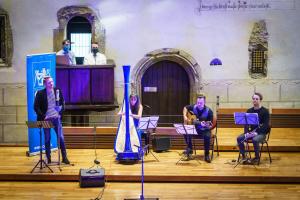
The ensemble SALOME - Band of Songs of Karel Kryl for vocals, harp, clarinet and guitar performed in the Bethlehem Chapel during a virtual concert on 5 May. Performers were Pavel Batěk, Barbora Plachá, Tomáš Kůgel and Petr Šťastný. The concert was an acknowledgment to all those who helped in any way in the mitigation of COVID-19, especially to experts and teams involved in a number of projects, but also to those who kept the teaching and research running in difficult conditions.
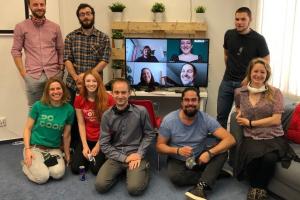
The first Czech student online hackathon UniHack: Innovate Czech Republic was held from 1 to 3 May. The aim of the competition was to come up with innovations that will help companies, institutions or organizations to mitigate the consequences of the current unfavorable situation. The event was attended by 112 hackers who had 55 specific challenges to solve. Hackathon was created on the initiative of students in cooperation with the Faculty of Information Technology CTU in Prague (FIT CTU), CEE Hacks, prg.ai and UNICO.ai and with the support of the capital city of Prague.
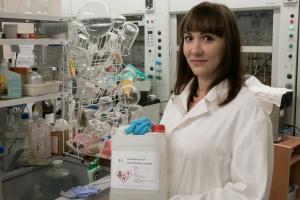
As soon as the number of confirmed COVID-19 infections began to increase in the Czech Republic, all disinfection disappeared from shops and warehouses. Its acute shortage was immediately addressed by the Department of Nuclear Chemistry (KJCH) at the Faculty of Nuclear Sciences and Physical Engineering of the Czech Technical University in Prague (FJFI), which practically started the production of AntiCOVID disinfection from day to day.

At the beginning of April, the doctor of Na Bulovce Hospital, RNDr. Lenka Richterová, Ph.D. contacted a group of CTU researchers who automate testing on Covid-19 using pipetting robots. Researchers and students of the Faculty of Electrical Engineering (FEE) and the Czech Institute of Informatics, Robotics and Cybernetics (CIIRC) were asked if they could design a tool to facilitate the opening of sample tubes. The current procedure of manual opening is very impractical and ultimately dangerous. It requires inserting a finger into the recess of the lid, turning it and then unfolding it. However, according to Richter, by applying this procedure, laboratory technicians have calluses and painful blisters that burst. In addition, tilting the cap to the side causes bubbles to contaminate the outside of the tube and laboratory gloves. Using more layers of gloves would make it impossible to hold the tube and cap firmly.

The GoDeliver logistics web platform mediates the delivery of food, medicine or veils to people in quarantine. The project works on the principle of involving couriers-volunteers from the public, who distribute the necessary resources to the needy. The platform, which was originally created to help companies deliver shipments, was developed by students of the Faculty of Information Technology and the Faculty of Electrical Engineering of the Czech Technical University in Prague.