
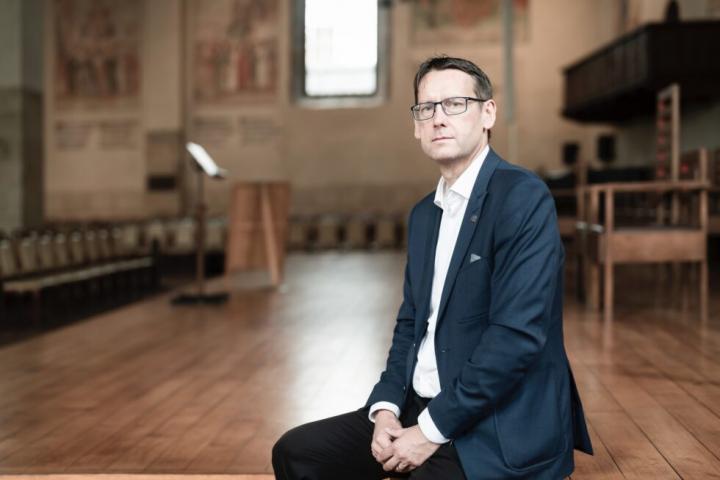
Vice-Rector, which faculties and institutes at CTU are involved in semiconductor research?
Semiconductor research at our university is spread across several faculties. These are the Faculty of Electrical Engineering (FEE), the Faculty of Information Technology (FIT), the Faculty of Nuclear Sciences and Physical Engineering, and the Faculty of Transportation Sciences. Two of our institutes also play an important role – the Czech Institute of Informatics, Robotics and Cybernetics and the Institute of Technical and Experimental Physics. This creates a very strong base across the entire CTU.
What areas do the individual teams focus on?
The strongest team in the field of semiconductors is Jiří Jakovenko’s team from the Department of Microelectronics at FEE, which is engaged in a wide range of research – from the design of analog and digital integrated circuits optimized using artificial intelligence, through the development of electronics for particle detectors and integrated circuits for power management, to the development of new CMOS transistor topologies. Their work in the development of MEMS sensors, energy harvesting, and printed sensors is also significant. Other groups at the Department of Microelectronics are engaged in the development of power semiconductors and carbide electronics, integrated optoelectronics, and the analysis of the thermal properties of components.
What projects are the teams at FIT and the Center for Applied Physics and Advanced Detection working on?
FIT has a working group led by Hana Kubátová that focuses on digital design and the reliability of electronic systems. They work on things like designing fault-tolerant circuits, calculating reliability parameters, implementing on FPGAs, and using Petri nets for hardware modeling. Algorithms and architectures for IoT and AI are a big topic.
The work of the Center for Applied Physics and Advanced Detection Systems is also significant, where they develop silicon detectors of various sizes, including large 40 × 40 cm² detectors for radiology. They design their own ASIC chips in CMOS technologies, read-out electronics, PCB boards, flex cables, firmware, and software for the complete operation of detection systems. Thanks to international cooperation, they are among the leading teams in the field of ionizing radiation detection.
How is this research reflected in teaching?
We try to reflect current trends. At FEE, we have a popular study program specializing in microelectronics, which is currently undergoing reaccreditation. Two separate programs will be created—one more focused on hardware, the other on software, which will allow for deeper specialization. It is also important that we involve students in research projects from the beginning of their master’s studies and collaborate with universities in Taiwan and Europe. Our doctoral students also play a major role.
Have you noticed growing interest among students in this field?
Definitely. Over the last two to three years, we have seen an increase in interest, which is also due to media coverage of the topic of semiconductors. Students are motivated by the fact that they are working on real projects with practical impact. In addition, they have excellent conditions – the opportunity to go abroad as part of Erasmus or the EuroTeQ alliance and close contact with industry, which is very interested in our graduates.
What role does CTU’s membership in the Czech Semiconductor Center play?
It is certainly an important platform, but we should not view it in isolation. The entire ecosystem that is beginning to be built in Czechia is key. Thanks to the Czech Semiconductor Center, we are able to communicate better with the public, but cooperation with companies and the creation of new startups or spin-offs is equally important. With the Czech National Semiconductor Cluster, it is possible to create a suitable background for these new entities.
But you also cooperate with Taiwan. On what specifically?
We work closely with the Taiwan Semiconductor Research Institute, which is part of the National Institutes of Applied Research, and with the National Taiwan University of Science and Technology, where we deal with chip designs, for example – what to make, from what, and how. It’s not just about design, but also materials, technology, and engineering. For example, TSMC in Taiwan is also looking for students specializing in mechanical engineering, which shows how broad this field is.
What are you most proud of in the field of semiconductors at CTU?
Our talented people who know how to collaborate with industry and foreign universities. The return of experts from the field who want to teach is also a great benefit, strengthening the entire ecosystem. The number of experts is growing not only in research but also in teaching, which for me is proof that we are heading in the right direction.
What is your relationship with your colleagues at Brno University of Technology? Is it more competitive or cooperative?
Both universities have strong expertise in chip design. We cooperate, but at the same time we compete to a certain extent, which I think is healthy—it motivates us to improve. In the future, we are ready to help other universities develop semiconductor research. There is rivalry between Prague and Brno, but it is not about spite – it is more about mutual progress and better cooperation with companies in individual regions.
Written by: Jana Franchi, News at BUT
Photo: Jiří Ryszawy, CTU